Introducing Broker Business: The Real Economics of an IB
How an introducing broker business really earns: revenue share vs CPA vs rebates, and why active traders and retention matter more than sign-ups. Plus red flags.
By Nexora Capital Markets — Editorial team
Published: Oct 24, 2026
Updated: Oct 27, 2026

Table of Contents
Most introductions to the introducing broker business start with a rate: a percentage, a tier table, a calculator that turns a hundred clients into a monthly figure. The rate matters, but it is the least interesting number in the business.
What decides whether an IB business is worth building is everything underneath the rate: which traders you bring, how actively and for how long they trade, and what it costs you to find and keep them. This guide sets out the economics of an introducing broker business as they actually work, without the fantasy.
Key takeaways
• An IB earns from the trading activity of the clients they introduce, not from sign-ups on their own.
• Revenue share, CPA and per-lot rebates reward different things; choose the model that suits how you build.
• A small group of active traders in month six is usually worth more than a large list of sign-ups in month one.
• Retention is the multiplier: a client who keeps trading keeps contributing every month.
• Any programme that promises a specific income is selling the fantasy, not the business.
1. Where IB income actually comes from
An introducing broker (IB) refers traders to a broker and is paid for the trading business those clients generate. The broker earns revenue when clients trade, mainly through spreads and commissions, and the IB's payout is linked to that revenue under the terms of the partnership agreement.
That single fact explains most of what follows. A registration on its own earns nothing. A funded account that never trades earns nothing. Income only exists where there is genuine, ongoing trading activity, which is why the quality of the clients you introduce matters far more than the quantity.
2. The three common IB payout models
IB programmes across the industry usually pay in one of three ways, or a mix of them.
Model | How it pays | What it rewards | The trade-off |
|---|---|---|---|
Revenue share | A share of the net revenue your clients generate, calculated periodically | Active, long-term clients | Builds gradually and moves with client activity |
CPA (cost per acquisition) | A one-off payment per client who meets set criteria | Volume of new qualified clients | Paid once, with nothing from that client afterwards |
Per-lot rebate | A fixed amount for each lot your clients trade | Trading volume | Can create pressure to encourage more trading, which rarely serves clients |
Hybrid | A combination, such as CPA plus an ongoing share | A mix of both | More moving parts to compare |
For reference, Nexora pays revenue share across multiple tiers. Your share applies to net revenue worked out each month from realised, closed positions, and the tier you sit on depends on your total net deposits and active clients, assessed at each month end, with a grace period if the numbers dip.
3. The four drivers of IB earnings
1. Client quality over client count
A trader who understands risk, sizes positions sensibly and trades with a plan is likely to still be trading in six months. A trader who arrived for a promotion, deposited the minimum and overleveraged their first position is not. Both count the same on a sign-up report and very differently on a revenue statement.
2. Activity over deposits
Deposits are the headline figure in most IB conversations, but revenue comes from trading. A smaller account that trades regularly can contribute more over a year than a large deposit that sits idle. Deposits still matter for tier qualification, so track both, but do not mistake one for the other.
3. Retention over acquisition
Every client you keep contributes again next month at no extra acquisition cost. Every client you lose has to be replaced, usually at a cost in time, content, or advertising. Small improvements in retention compound in a way that new sign-ups rarely do.
4. Structure over headline rate
A tier structure only helps if you can see how it works. Know what qualifies you for each tier, how often qualification is reviewed, what happens if your base falls and whether the terms can change. A clear structure you can plan around is worth more than a headline rate you cannot rely on.
4. A simple illustration
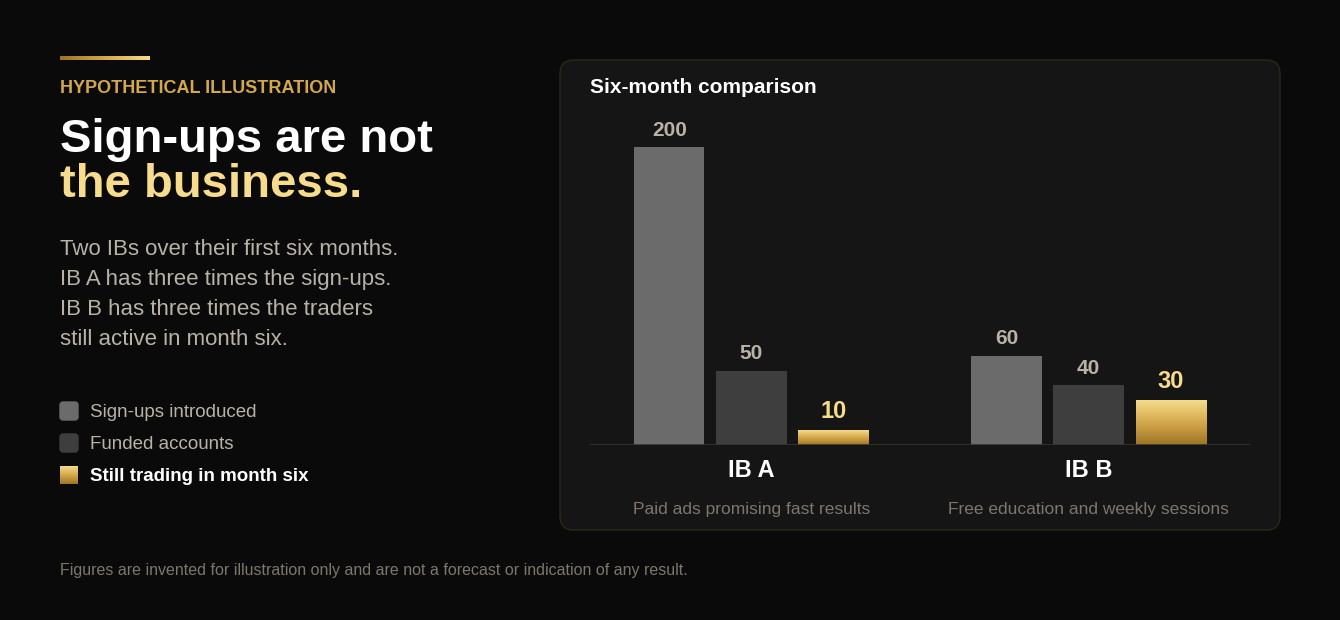
Consider two hypothetical IBs over their first six months. The figures are invented for illustration only and are not a forecast or indication of any result.
IB A | IB B | |
|---|---|---|
Sign-ups introduced | 200 | 60 |
Funded accounts | 50 | 40 |
Still trading in month six | 10 | 30 |
How they found clients | Paid ads promising fast results | Free education and a weekly market session |
IB A has the better-looking sign-up report. IB B has the better business: three times as many active traders, built on trust rather than promises, and far less need to keep replacing clients who leave.
5. The costs nobody puts in the pitch
• Time. Content, community management, and answering client questions are the real work of an IB business, and they take hours every week.
• Marketing spend. Paid traffic can bring sign-ups quickly, but low-quality sign-ups rarely become active traders.
• Churn. Some clients will stop trading or lose interest. Plan for it rather than assuming every client stays.
• Uneven months. Revenue share moves with client activity, so quiet markets mean quieter months.
• Local rules. Depending on where you and your audience are, there may be rules on how trading can be promoted. Check them before you start.
• Reputation. Your name sits on every introduction, so a poor client experience at the broker costs you too.
6. What the broker should carry for you
The partnership works best when the IB focuses on relationships and the broker carries the operational load. At Nexora, that means:
• Onboarding and verification, with our desk following each client through to first deposit.
• Funding through more than 50 deposit and withdrawal methods, with availability varying by country.
• Client support around the clock, for you and for your clients.
• A live IB portal where every client and every commission line is visible as it happens.
• Marketing materials (banners, landing pages, referral links and social content) ready from your first week.
• A named partner manager rather than a ticket queue.
7. Red flags in IB economics
• An income figure in the pitch. No programme can predict what you will earn, so a projected monthly figure is marketing, not economics.
• A plan that only works at an unrealistic pace. If a tier or bonus is only reachable by recruiting faster than you can support clients, it rewards churn.
• Pressure to push clients into more trading. It shortens client lifetimes, which is the opposite of what makes the business grow
The contractual side (negative months, changes to terms and what happens if the partnership ends) is covered in our guide to the awkward questions to ask about an IB programme.
8. Building an IB business that lasts
The IB businesses that last tend to look alike. They educate before they promote. They attract traders who understand that losses are part of trading. They stay in touch after the sign-up, not just before it. And they choose a broker whose operations they can stand behind, because every client experience reflects on them.
The economics of an introducing broker business reward patience: active clients, kept for longer, on terms you can plan around. Before you sign anything, check the broker itself: our guide to what a forex broker licence does explains how. To talk through how the Nexora partnership works, the partnership desk is open.
Frequently asked questions
How do introducing brokers make money?
An introducing broker is paid by the broker for the trading business generated by the clients they refer, usually through revenue share, a one-off CPA payment, per-lot rebates, or a mix of these.
What is revenue share in an IB programme?
Revenue share pays the IB a portion of the net revenue generated by the clients they introduce, calculated over a set period. In tiered programmes, the share depends on which tier the IB qualifies for.
Is CPA or revenue share better for an IB?
Neither is better in general. CPA pays once per qualified client, while revenue share pays over time for as long as clients keep trading, so it tends to suit IBs who focus on education and retention.
How is IB commission calculated?
It depends on the programme. Nexora works out net revenue each month from realised, closed positions across your client base, and your tier sets the share applied to it.
How many clients does an IB need?
There is no fixed number. A smaller base of active, long-term traders can outweigh a much larger base of inactive accounts, which is why activity and retention matter more than sign-up count.
Can an IB programme guarantee income?
No. IB earnings depend on client activity, tier qualification, and market conditions, so any promise of a specific income should be treated as a red flag.
Disclaimer: Risk warning: Trading leveraged products such as forex and CFDs carries a high level of risk and may not be suitable for every investor. You may lose some or all of your invested capital. This article is for educational purposes only and is not investment advice. Nexora Capital Markets Ltd (Company Number: 237992 GBC) is licensed by the Financial Services Commission, Mauritius (licence no. GB26206605). Revenue share depends on tier qualification and is not a forecast or indication of actual earnings.